How to Protect Your Hives From Predators and Pests
Disclosure: First Hive Gear may earn a commission if you buy through links on this page, at no extra cost to you.
Almost everything that lives near a beehive wants something from it. A bear is after the brood and honey, and a skunk wants the guard bees. Mice are looking for a warm box to spend the winter in, while beetles and moths go for the comb itself. None of that means your colony is doomed, but each one needs its own fix, and most of those fixes are cheap if they go in before the problem starts.
Below I go through the predators and pests a first-year beekeeper in the U.S. is most likely to meet, with the signs of each one and what to put in place. I haven’t tested these products myself. The advice comes from university extension guides and government agencies such as USDA, plus a few supplier listings for prices. Everything is cited at the bottom.
- Quick reference
- Bears
- Skunks, raccoons and opossums
- Mice
- Robbing bees
- Yellowjackets and wasps
- Small hive beetles
- Wax moths
- Birds, ants and the rest
- A note on giant hornets
- What to buy first
- FAQ
The short answer
Keep your colonies strong. Nearly every extension guide I read comes back to that, because a crowded hive with plenty of guard bees fights off beetles, moths, wasps and robbers on its own. Then add the physical defenses that fit where you live. Every hive should have an entrance reducer and sit on a stand with a strap around it. If bears live anywhere near you, build an electric fence before the bees arrive. Put a mouse guard on in fall.
Quick reference: what you’ll see and what to do
| Pest | What you’ll notice | First fix |
|---|---|---|
| Bears | Boxes knocked over, frames scattered, brood comb eaten, usually overnight | Baited electric fence around the whole apiary |
| Skunks | Scratch marks and muddy prints on the landing board, chewed clumps of dead bees on the ground, bees that are suddenly defensive | Raise the hive on a stand; add carpet tack strip at the entrance |
| Raccoons | Hives tipped over or partly pulled apart | Strap the boxes to the stand |
| Mice | Chewed comb and frames, a nest and urine stains in the bottom box, often found at the first spring check | Mouse guard or small entrance from fall on |
| Robbing bees | Fighting at the entrance, bees trying to get in at the cracks between boxes, wax bits on the bottom board | Shrink the entrance; close the hive; clean up syrup |
| Yellowjackets | Wasps hovering at the entrance and carrying off bees, mostly late summer and fall | Smaller entrance, robbing screen, traps set away from the hives |
| Small hive beetles | Small dark beetles in the hive, often in the honey supers; slimy, fermenting comb in bad cases | Strong colony, no extra boxes, oil traps between frames |
| Wax moths | Silk webbing and tunnels through comb, mostly in weak hives and stored boxes | Freeze stored comb, then store it with light and air |
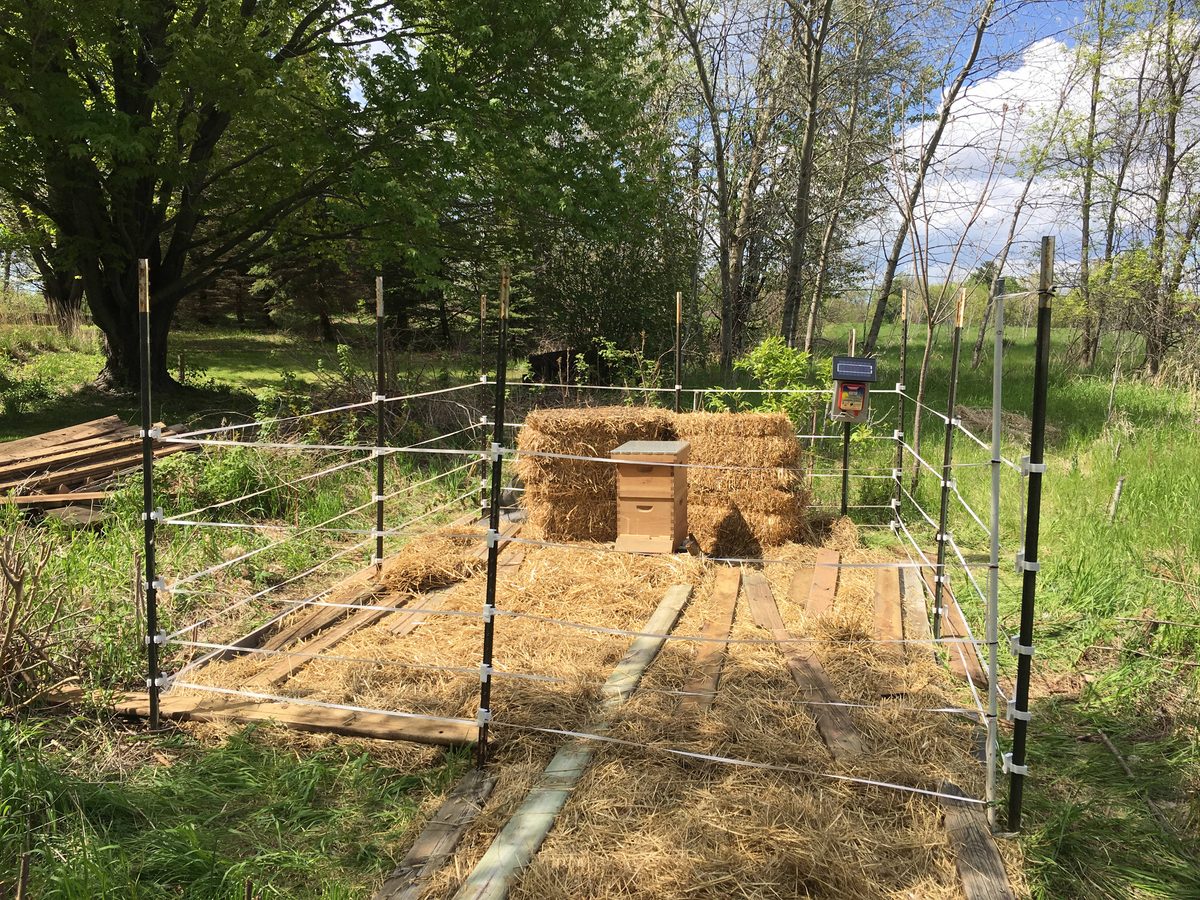
Bears: an electric fence, built early
A bear does more damage in one night than anything else on this list. Penn State’s quick reference says bears usually come at night, smash the hives to get at brood and honey, and come back again and again once they’ve found a bee yard. A 1990 survey of state and provincial apiary inspectors ranked bears the most serious vertebrate pest of beekeeping, and electric fencing was the method they used most to stop them.
Timing matters more than most people think. The Mid-Atlantic Apiculture Research and Extension Consortium (MAAREC) says the fence has to go up before bears start damaging colonies, and that a fence is of little help once a bear has made your apiary part of its route. If you’re in bear country, treat the fence as part of setting up the site, the same as the hive stand.
How to set it up
- Surround the whole apiary. UConn Extension runs strands at 4, 16, 26 and 36 inches off the ground, pulled tight with no sag. A bear’s nose is about knee height, so the low wires matter most.
- Leave room between the fence and the hives. Texas A&M AgriLife suggests 3 to 5 feet, so the bear meets the wire before it can reach anything.
- Buy an energizer rated for bears. Texas A&M says you need at least 0.7 to 1.0 stored joules (0.5 to 0.7 output joules), a low-impedance unit, and 45 to 60 pulses a minute. Cheap low-joule chargers made for pets won’t stop a bear.
- Ground it well. Poor grounding is the most common reason these fences fail, according to Texas A&M. UConn drives its ground rod 5 feet into moist soil.
- Bait the wires. Vermont Fish & Wildlife says an unbaited fence isn’t effective against bears. Smear peanut butter or bacon grease on a lower strand so the first shock lands on the bear’s nose, and refresh it every few days to two weeks depending on the bait. MAAREC warns that without bait, a bear is likely to crash straight through, because its fur insulates it the same way it blocks stings.
The guides don’t agree on voltage. UConn says 3,000 volts is enough, while Texas A&M says bears need 5,000 to 7,000 volts depending on the bear. I’d aim for the higher number and check it with a fence voltage meter. Mow under the wires too, and keep the fence away from overhanging branches. MAAREC notes that bears will climb a tree and drop in from above.
Learn more: UConn Extension, “Protecting Beehives from Bears”
Skunks, raccoons and opossums: stands, tack strips and straps
Skunks are the predator you’re most likely to deal with. In the 1990 inspector survey they were named more often than any other animal. They come at night, scratch at the entrance, and eat the guard bees that walk out to check on the noise. Mississippi State Extension says the giveaways are scratch marks on the landing board and chewed-up wads of dead bees on the ground in front. Mississippi State says skunks seem to pick the most defensive colony and return night after night, which can wear a strong colony down and make it testy when you open it.
Raise the hive
Getting the entrance off the ground forces a skunk to stand up to reach it, which puts its belly in reach of the bees. How high depends on the guide. Utah State Extension uses a stand or cinder blocks to get the hive 12 to 18 inches up. Mississippi State says more than 18 inches, and Penn State goes as far as 3 feet, with aluminum guards on the legs if skunks try to climb. For most backyards I’d start at 18 inches. That’s also a comfortable working height, and you can always go higher if the scratching continues.
Add carpet tack strip at the entrance
Apiary inspectors surveyed for a 1990 Vertebrate Pest Conference paper listed boards with nails, carpet tack strips and chicken wire stapled to the hive front as ways to keep skunks away from the entrance. Tack strip is the cheapest of those. It’s the thin wooden strip with angled points that holds wall-to-wall carpet down, sold at any hardware store. I’d nail a piece along the front edge of the landing board with the points up, so a paw that reaches for the entrance gets jabbed. The bees walk right over it.
Strap the boxes down
Raccoons can tip hives over and partly break them up, and the same survey says their damage sometimes gets mistaken for a bear’s. Opossums raid entrances the way skunks do and also chew the wood around them. Utah State suggests a heavy rock on top or a strap around the hive to protect it from raccoons, skunks and wind. A ratchet strap that runs around the boxes and under the stand or bottom board holds everything together and costs a few dollars. It won’t stop a bear, though.
Penn State’s skunk fact sheet points out that skunks are rabies carriers and can’t be relocated in Pennsylvania. Trapping rules vary by state, so if exclusion doesn’t work, call your state wildlife agency before you set a trap.
Learn more: Penn State Extension, “Skunks: Solutions to Common Problems”
Mice: a guard on the door before winter
Mice move in once the weather turns cold and the bees pull into a tight cluster away from the entrance. Penn State says they chew comb and frames to make room for a nest, and their urine on the comb makes the bees reluctant to clean up in spring. You usually find the damage at the first spring inspection, when it’s too late to do much about it.
The fix is a smaller hole. The 1990 inspector survey found that a standard wooden entrance reducer, often about 3/8 inch high and 3 inches wide, still lets small mice through. A row of 3/8-inch round holes keeps them out. Mississippi State recommends putting a mouse guard on after you’ve finished your winter prep. I explain the timing, and how to make a guard from hardware cloth, in fall feeding and winter prep.
One thing to check before the guard goes on: open the bottom box and make sure no mouse has already moved in. If you shut one inside with the bees, the guard keeps it there.
Learn more: O’Brien and Marsh, “Vertebrate Pests of Beekeeping” (Vertebrate Pest Conference, 1990)
Robbing bees: reducers and robbing screens
Sometimes the threat is other honey bees. When nectar runs short, foragers from strong colonies look for a weak hive they can empty, and UF/IFAS says a colony can lose all its honey to robbers in a matter of hours or days. Robbing also spreads mites and disease between colonies. In many cases, UF/IFAS adds, the beekeeper is the one who starts it, by leaving boxes open or spilling syrup.
Learn to spot it. Normal traffic at the entrance is calm and steady. Robbing looks frantic: lots of bees flying in front of the hive, fighting at the entrance, and bees trying to squeeze in at the cracks between boxes or under the lid. You may see bits of chewed wax capping on the bottom board.
To stop it
- Close up any hive you have open, and clean up or cover any honey or syrup.
- Shrink the entrance of the colony being robbed. In cool weather UF/IFAS takes it down to a gap that lets only one to five bees through at a time.
- Tape over gaps between boxes. Smoke doesn’t help, according to UF/IFAS.
- If none of that works, move the weak colony to another yard until it’s strong again.
To prevent it, use entrance reducers on every hive during a dearth, keep inspections short, and feed late in the day. A robbing screen helps too. It covers the entrance and moves the way in to a side opening. The Bee Smart Ultimate Robbing Screen at Blythewood was $12.95 when I checked on Oct 15, 2026. Blythewood says the resident bees learn the new opening within about a day, while robbers keep bumping into the screen at the old spot, and that it doubles as a mouse guard.
Learn more: UF/IFAS, “Robbing Behavior in Honey Bees”
Yellowjackets and wasps: tighten up, then trap
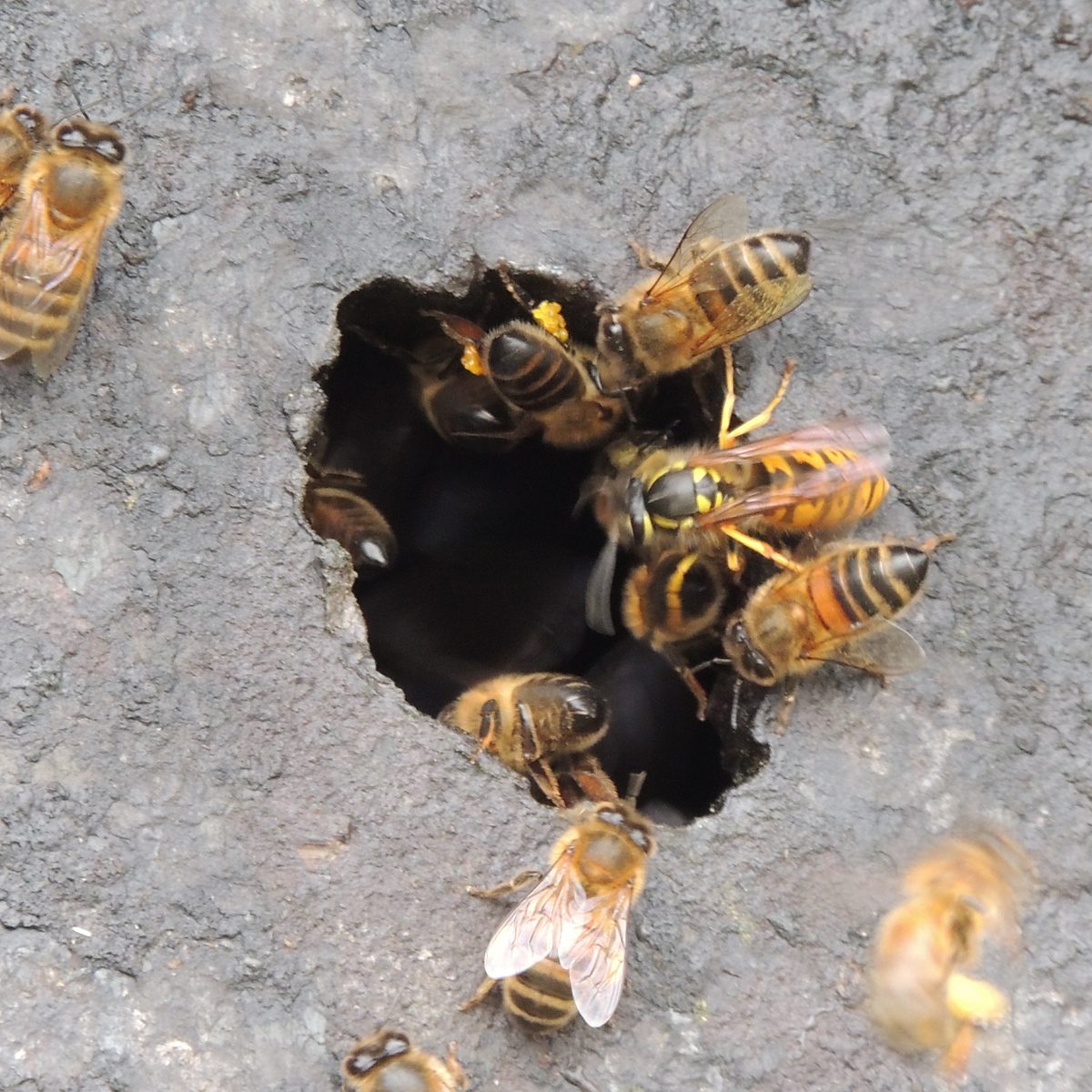
Yellowjackets show up in late summer and fall, when their own food gets scarce. Oregon State Extension says they rob honey and catch adult bees, and heavy pressure can kill a weak colony. A dry year with an early end to the nectar flow makes it worse.
Oregon State’s advice puts colony management ahead of trapping. Keep colonies strong, fix gaps in old woodenware, use entrance reducers and robbing screens, and keep the apiary tidy. Wax scrapings and spilled syrup both draw wasps in. If a colony is already under attack, Oregon State cuts the entrance to 1 to 2 inches and suggests running a lawn sprinkler next to the hive to discourage flying.
Traps help, with limits. Lures with heptyl butyrate attract yellowjackets and, according to Oregon State, don’t attract honey bees. Never bait a homemade trap with anything sugary. Set traps low to the ground and at least 20 feet from the hives, so the wasps don’t find the bees while they’re checking out the trap. Traps set in spring catch queens before they start nests. Oregon State is honest that casual trapping rarely cuts the population enough to matter, so I’d think of traps as a backup.
Learn more: Oregon State Extension, “Protecting Honey Bees from Yellowjacket Wasps”
Small hive beetles: strong colonies and oil traps
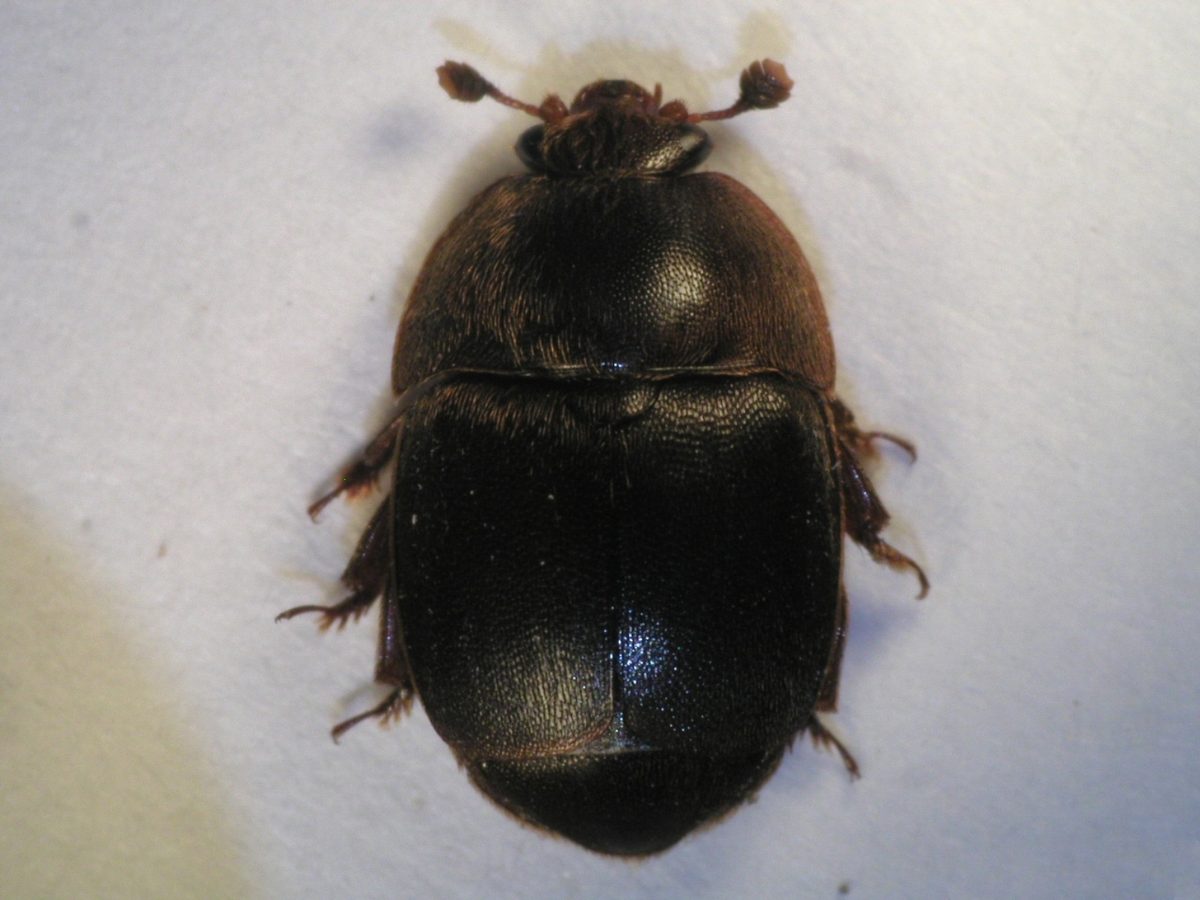
The small hive beetle came from Africa. USDA ARS calls it a serious pest in the U.S., especially in the Southeast. A few adults in a strong hive are normal. Mississippi State says hundreds can live in a healthy colony without doing much. The larvae cause the damage. In a weak colony they tunnel through comb, and a yeast they carry turns the honey into a fermenting, slimy mess that can make the bees abandon the hive. When the larvae are done feeding, they crawl out and burrow into the soil to pupate.
USDA ARS and the LSU AgCenter put out a list of ten management practices. The ones that matter most for a backyard hive:
- Don’t give the bees more room than they can guard. Extra supers and empty frames give beetles places to hide.
- Put hives in the sun. Research cited in the guide found that traps in shaded parts of an apiary caught more beetles.
- Feed only as much pollen patty as the bees eat in two days. Leftover patty feeds beetle larvae.
- Extract honey within two to three days of pulling the supers, and clear out dead colonies right away.
For the adults, UF/IFAS describes in-hive traps that use apple cider vinegar as bait and mineral oil to drown the beetles. Some hang between frames, and others sit on the bottom board. A reusable Beetle Jail trap was $3.25 at Blythewood on Oct 15, 2026, and an 8 oz bottle of trap oil was $9.95. Mississippi State warns against using roach baits with fipronil, which is highly toxic to bees.
Learn more: USDA ARS and LSU AgCenter, “Small Hive Beetles: Ten Best Management Practices” (PDF)
Wax moths: protect the comb you store
Wax moth larvae eat comb, leaving silk webbing and tunnels behind, and the big ones chew grooves into the wooden frames. UF/IFAS says wax moths are in nearly every colony but a healthy one keeps them in check, so heavy damage in a live hive usually means something else weakened it first. There’s no chemical treatment for wax moths in a living colony. The answer is to fix whatever is wrong with the bees.
Stored comb is where you lose the most. Supers you pull in fall, and frames from a colony that died, are open to moths unless the weather stays cold. Penn State says wax moths stay a threat until temperatures drop below 40°F.
- Freeze it first. This kills eggs and larvae you can’t see. Mississippi State freezes comb at 0°F for 48 hours. UF/IFAS says at least 72 hours, so I’d leave it in for three days. Frozen wax is brittle, so handle it gently.
- Then store it with light and air. UF/IFAS stacks supers crosswise in an open-sided shed so light and air move through. Moths prefer dark, old brood comb in closed stacks.
Don’t reach for mothballs. Mississippi State warns that naphthalene gets into honey and makes it unfit to eat. Any product you put on stored comb has to be labeled for that use.
Learn more: UF/IFAS, “Wax Moth Control”
Birds, ants and the rest
Plenty of birds eat bees, including kingbirds and martins. MAAREC says they take very few, though. The exception is a bird catching a young queen on her mating flight, which mostly matters to queen breeders. Woodpeckers can drill into hive boxes. MAAREC suggests scaring them off or screening the hive, and the 1990 survey paper notes that wrapping colonies in wire mesh works and that killing a woodpecker in the U.S. requires a federal permit.
Ants are usually a nuisance more than a threat. Penn State says you’ll mostly find them between the inner and outer covers. Mississippi State says Argentine ants can take down a small or weak colony, and suggests a sticky barrier such as petroleum jelly on the stand, or setting the stand’s feet in shallow cans of oil. Spiders and earwigs need no control, according to Penn State.
Learn more: MAAREC, “Pests of Honey Bees” (PDF)
A note on giant hornets in North America
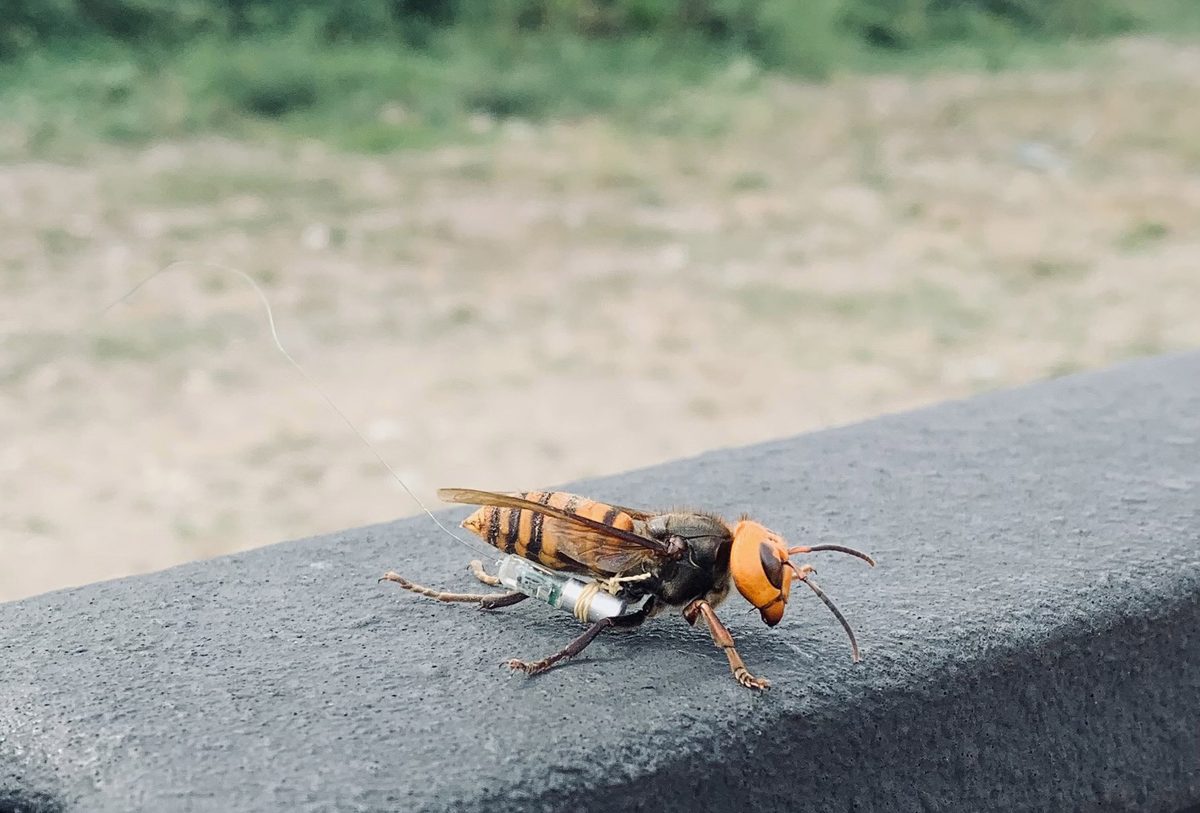
You may remember the “murder hornet” scare. The northern giant hornet (Vespa mandarinia), the world’s largest hornet, was found near Blaine, Washington, in late 2019. The Washington State Department of Agriculture (WSDA) found and destroyed four nests in Whatcom County in 2020 and 2021, using radio tags on live hornets to follow them home. After three years with no detections, WSDA and USDA declared the hornet eradicated from the United States at the end of 2024.
A different species is now the one to watch. WSDA notes that the yellow-legged hornet was detected in Georgia in August 2023 and in South Carolina that November. A live one was photographed at the Port of Vancouver, Washington, in April 2026. WSDA says this hornet has caused up to 30% losses of honey bee hives in parts of Europe. If you see an unusual hornet or a hive attack, take a photo and report it to your state’s agriculture department or apiary inspector. Don’t try to deal with a nest yourself.
For something less alarming, Japanese honey bees have their own defense against giant hornets. I wrote about it in Old Hives Made New.
Learn more: Washington State Department of Agriculture, “Hornets”
What to buy first
You don’t need all of this on day one. Here’s the order I’d buy in for a single backyard hive:
- An entrance reducer. Many hive kits include one. If yours didn’t, Blythewood lists wooden entrance reducers at $2.25 each (Oct 15, 2026).
- A hive stand or a pair of cinder blocks, plus a ratchet strap from the hardware store.
- An electric fence, before the bees arrive, if you’re anywhere bears are reported.
- A robbing screen by midsummer, when the nectar dearth starts in most places.
- Beetle traps if you’re in the South or start seeing beetles at inspections.
- A mouse guard in fall.
Tack strip and straps cost a few dollars. A bear fence is the big expense. MAAREC pointed to a Pennsylvania Game Commission design that cost about $450 when the guide was revised in 2014, so expect more now. I list the rest of the starting gear in the beginner equipment checklist, and the full budget is in how much it costs to start beekeeping.
Frequently asked questions
Do I need a bear fence if I’ve never seen a bear?
If bears are reported in your county, I’d build one. MAAREC says the fence has to go up before a bear finds the hives, because a bear that has already fed there is hard to turn away. Your state wildlife agency can tell you whether bears are active near you.
Something is scratching at my hive at night. How do I tell what it is?
Muddy scratch marks on the landing board and chewed clumps of dead bees on the ground point to a skunk, according to Mississippi State. A tipped or pulled-apart hive is more likely a raccoon, and a bear leaves smashed boxes with frames scattered across the yard.
Will a robbing screen keep out yellowjackets?
It helps. Oregon State says robbing screens let resident bees in and out while deterring yellowjackets. Pair it with a reduced entrance and a strong colony.
I found a few beetles in my hive. Should I worry?
A few adults in a busy hive are normal. Watch for larvae in the comb or honey that looks wet and smells sour. That’s when traps and a closer look at colony strength matter. Mention it to your local club too, since beetle pressure varies a lot by region. I cover what else to look for on each visit in your first hive inspection.
Sources
- UConn Extension, “Protecting Beehives from Bears” (EXT119, May 2025)
- Texas A&M AgriLife Extension, “Bear Deterrent Fencing”
- Vermont Fish & Wildlife Department, “Protect Your Property with a Zap”
- MAAREC, “Bees and Bears” (Publication 4.10, 2014, PDF)
- MAAREC, “Pests of Honey Bees” (Publication 4.3, PDF)
- Penn State Extension, “A Quick Reference Guide to Honey Bee Parasites, Pests, Predators, and Diseases”
- Penn State Extension, “Skunks: Solutions to Common Problems”
- Mississippi State University Extension, “Minor Pests of Honey Bees in Mississippi” (Publication 3195)
- Utah State University Extension, “Setting Up and Placing a Hive”
- O’Brien (Nevada Dept. of Agriculture) and Marsh (UC Davis), “Vertebrate Pests of Beekeeping,” Proceedings of the 14th Vertebrate Pest Conference (1990)
- UF/IFAS, “Robbing Behavior in Honey Bees” (ENY-163)
- Oregon State University Extension, “Protecting Honey Bees from Yellowjacket Wasps” (EM 9211)
- UF/IFAS, “Small Hive Beetle, Aethina tumida Murray” (EENY-474)
- USDA ARS and LSU AgCenter, “Small Hive Beetles: Ten Best Management Practices” (PDF)
- UF/IFAS, “Wax Moth Control” (ENY-121)
- Washington State Department of Agriculture, “Hornets”
- USDA APHIS, “Victory Over the World’s Largest Hornet Species”
- Blythewood Bee Company, Bee Smart Ultimate Robbing Screen listing (checked Oct 15, 2026)
- UF/IFAS Honey Bee Research and Extension Laboratory, “Small Hive Beetles | Beekeeping Academy | Ep. 77” (YouTube)
Top photo: an electric fence around a hive, put up to keep bears out. Photo: USDA photo by Brian Maedke, public domain, via Wikimedia Commons
This article is general information, not professional or legal advice. Wildlife and pesticide rules vary by state. Check with your state wildlife agency before trapping any animal, and always follow the label on any product you put in or near a hive.