What to Plant for Honey Bees: A Season-by-Season Guide
Planting for your bees feels like the most natural thing a new beekeeper can do. It also comes with a catch that most planting lists skip. A colony forages over thousands of acres, so a backyard bed is a small slice of its diet. What a garden can do is fill the weeks when little else is blooming nearby, and that’s where I’d put the effort.
Below I go season by season through the plants honey bees use most in the U.S., then cover trees, herbs, lawns and cover crops, the plants I’d be careful with, and water. I haven’t grown all of these myself. The lists come from university extension guides, research papers and the Pollinator Partnership, and everything is cited at the bottom. Bloom dates shift a lot with latitude, so treat the months as a rough guide and check your own region’s list.
- Quick reference
- How far bees fly
- Season by season
- Trees and shrubs
- Perennials and herbs
- Clover lawns and cover crops
- Native plants and your region
- How to plant, and water
- Plants to be careful with
- FAQ
The short answer
Plant for the gaps. In most places that means very early spring, when colonies are building up and little is open, and the summer dearth between the spring and fall flows. Early-blooming trees and shrubs cover the first gap. Heat-tolerant herbs, a patch of buckwheat or a clover lawn help with the second. Plant each kind in a clump, buy plants grown without systemic insecticides, and skip anything invasive in your state. Put out a water source too. Bees need it every day in hot weather, and it’s the easiest thing on this list to provide.
Quick reference: what blooms when
| Bloom time | Plants | Notes |
|---|---|---|
| Late winter to early spring | Willows, red and other maples, witch hazel, redbud, dandelion | Mostly pollen for brood. In north Florida, maples and willows bloom in January |
| Spring | Fruit trees, serviceberry, blueberry, black locust, tulip poplar | The main nectar flow in many areas |
| Early summer | Basswood (linden), sumac, white clover, sweet clover, catmint, borage | Basswood’s bloom is short but heavy |
| Midsummer dearth | Basil, oregano, thyme, anise hyssop, buckwheat | The leanest stretch in many areas. Deadhead perennials so they rebloom |
| Late summer to fall | Goldenrod, asters, bluebeard (Caryopteris) | Goldenrod and asters are major fall sources across much of the country |
How far bees fly, and what one yard can do
Clemson Extension says honey bees tend to forage within about 2 miles of the hive. A circle that size covers roughly 8,000 acres, which puts a quarter-acre lot in perspective. Over a year, a colony needs something like 125 kg (about 275 pounds) of nectar and 25 kg (about 55 pounds) of pollen, according to figures from bee biologist Tom Seeley cited in a 2016 paper in PeerJ. No backyard garden supplies that.
Ohio State’s honey plant fact sheet says the same thing in a beekeeper’s terms. It’s generally not economical to grow a crop for honey bees alone, and beekeepers mostly depend on wild plants and crops grown for other reasons. Bees are also picky in a sensible way. Clemson notes they’re very good at finding the most productive flowers within range, so a big flow down the road can pull them past your flower bed.
Timing is where a garden earns its keep. A team at the University of Sussex decoded 5,097 waggle dances over two years in a mixed town and farm landscape in England. In spring the bees foraged an average of 493 meters (about a third of a mile) from the hive. In summer that jumped to 2,156 meters (about 1.3 miles), and the area they used was 22 times larger. The authors read that as summer being the hardest season to find food, and the time when added flowers would help most. Your local dearth may fall at a different time, but the lesson carries: find the weeks when your bees are working hardest for the least, and plant for those.
The way to tell how your colony is eating is to look. I cover reading pollen and honey stores on the frames in your first hive inspection.
Season by season
Rutgers says colonies need a varied and plentiful sequence of flowers through the season, and that gaps anywhere from February through November can weaken them. The months below come mostly from Ohio State’s bloom list, so expect things to open earlier in the South and later up north.
Late winter and early spring
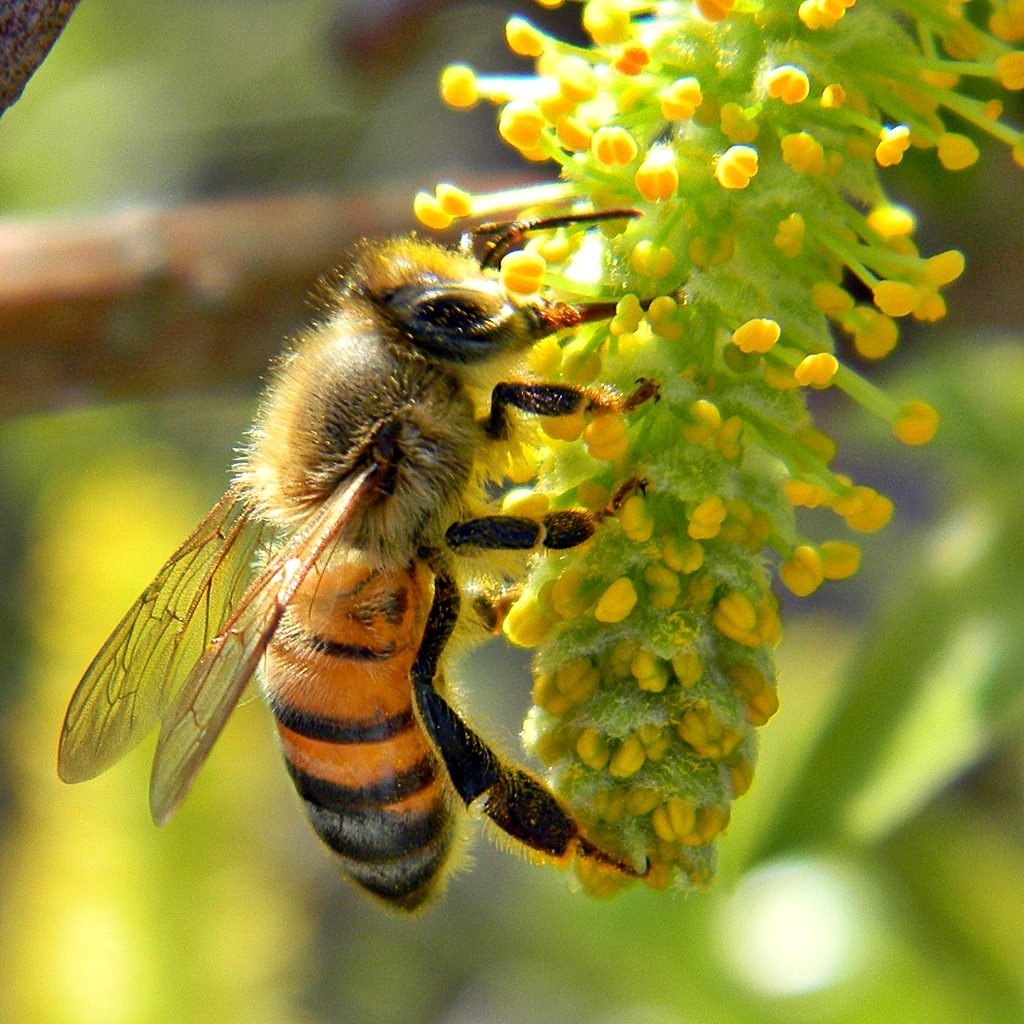
This is the first gap. Rutgers singles out warm days in early spring, when bees leave the hive looking for food and find very little open. The colony is raising brood fast by then, so pollen matters most. Willows and maples bloom from about February to April in Ohio, and Ohio State notes that maple rarely makes surplus honey. That’s fine, because its value is in early pollen and nectar for buildup. Witch hazel, pussy willow, redbud and spicebush are on Rutgers’ early list, and dandelions follow in April and May. In north Florida, UF/IFAS lists maples and willows blooming as early as January.
Spring
In many areas this is when the main flow happens, and trees supply much of it. Black locust and tulip poplar bloom in May and June in Ohio. Fruit trees, serviceberry and blueberry open from April into June on Rutgers’ list. In north Mississippi, the state’s extension calendar puts the main flow from late March through early June. If you only plant one thing for spring, I’d make it a flowering tree.
Early summer
Basswood blooms in June and July in Ohio. The bloom is short but it’s a good honey plant, and Clemson calls it an exceptional nectar producer. Sumac blooms at the same time. White Dutch clover and sweet clover carry a lot of colonies through this stretch, and garden plants like catmint (June to September) and borage (June to frost) start up.
The summer dearth
After the spring flow, many areas go quiet. Mississippi State’s calendar says that from mid-June through August most of north Mississippi lacks food plants, and brood rearing and comb building drop off. Mississippi State’s gardening guide suggests heat-loving plants such as basil for this period. It also says many summer perennials will keep reblooming for months if you deadhead or cut them back. Buckwheat is another option here. It flowers in July and August in Ohio, and I cover it below.
A dearth is also when robbing and yellowjackets get bad, which I go through in protecting your hives from predators and pests. If a colony runs light on stores, plants won’t fix it in time. Feeding will, and I explain how in fall feeding and winter prep.
Fall
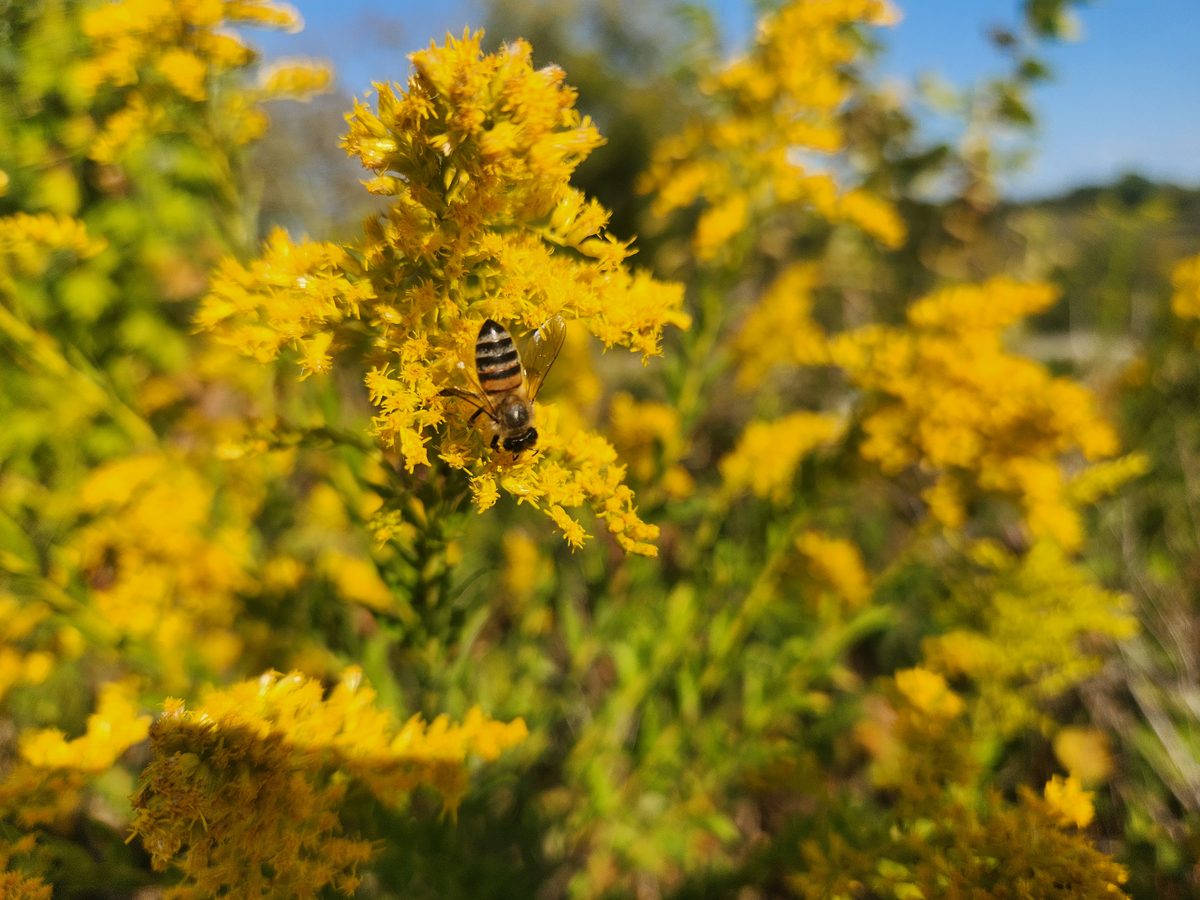
Goldenrod and asters are the big two. Ohio State lists goldenrod for September and October and asters from September until frost. Mississippi State calls both major fall nectar sources. Ohio State notes that goldenrod honey has a strong odor. Goldenrod also gets blamed for hay fever, but Mississippi State points out that ragweed is the real culprit. If goldenrod and asters already grow along a fence line or ditch near you, leaving them unmowed until frost may help your bees more than anything you plant.
Zachary Huang of Michigan State goes through his state’s major honey plants with his own photos. The list is Michigan’s, but most of the trees and wildflowers grow across the Northeast and Midwest.
Learn more: Rutgers NJAES, “Blooms for Bees: How to Provide Pollen and Nectar Sources”
Trees and shrubs: the most flowers per square foot
One mature tree in bloom holds more flowers than a whole garden bed. Mississippi State says flowering trees and shrubs provide the bulk of early-season forage, and Penn State’s Center for Pollinator Research calls them particularly important for spring pollinators. In South Carolina, Clemson says, native trees are often the most important nectar sources of all.
Clemson’s list of widespread nectar trees includes red maple, tulip poplar, dogwood, redbud, willows, black cherry, American holly, persimmon and black gum. Farther up into the hills it adds black locust, basswood and sourwood, which Clemson calls the most coveted nectar tree in the region for its light, sweet honey. For shrubs, Clemson lists blackberries, blueberries, sumac, elderberry and Virginia sweetspire among the most productive. Many of these also give you fruit or shade, which makes them an easy sell for a yard.
Trees take years to reach full bloom, so I’d plant them first and fill in with perennials while they grow.
Learn more: Clemson Cooperative Extension, “Land Use and Forages”
Perennials and herbs
Color matters more than you’d think. Mississippi State says honey bees don’t see red well and seldom visit red flowers. They’re most drawn to white, blue and violet, which explains why purple herbs and asters are always covered.
Herbs are the easy win, especially for the summer gap. Mississippi State’s honey bee favorites include rosemary, thyme, basil and oregano, and its herb table adds lavender, sage, chives and other alliums, and anise hyssop. A few notes from that guide:
- Basil thrives in late summer heat. Let some of it flower instead of pinching every bud.
- Oregano blooms from late spring or early summer and keeps going for months if you keep the plants compact.
- Lavender is prone to root rot, so give it well-drained mounds or containers.
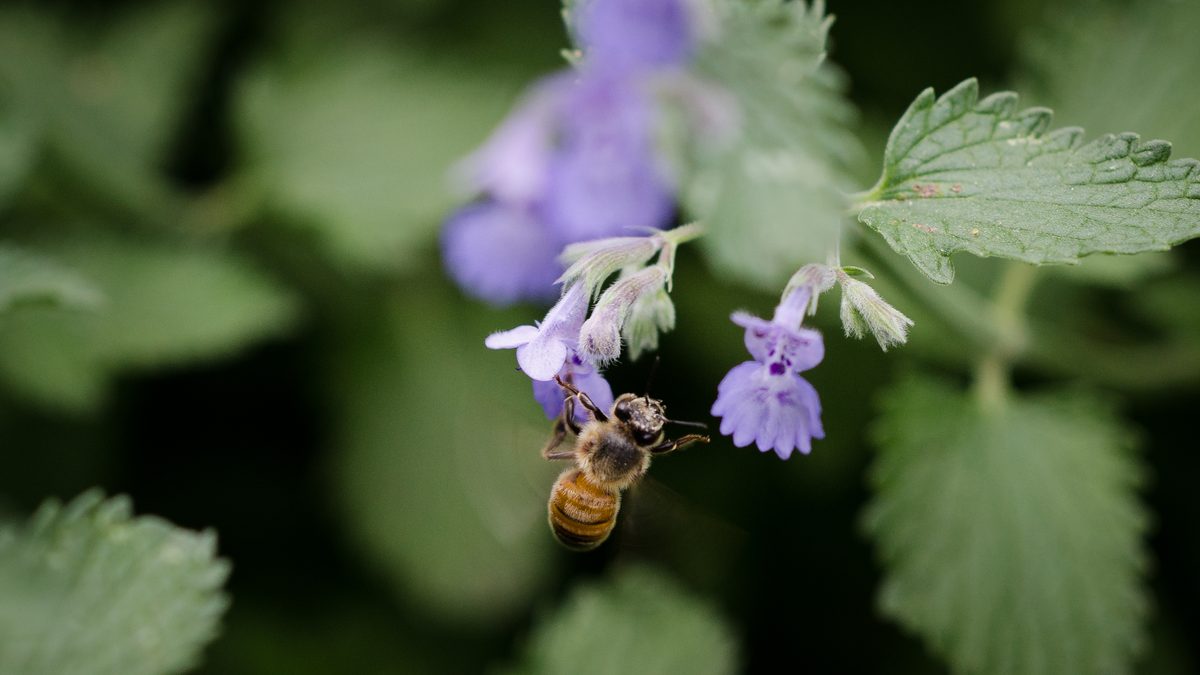
Ohio State adds catmint, which blooms June to September, and borage, which runs from June until frost. The top photo on this page is a bee on catmint in the USDA’s garden in Washington, D.C.
For perennials, Mississippi State lists asters, goldenrod, coneflowers, blazingstar, wild bergamot (Monarda), coreopsis and blue mistflower. It also recommends two non-native, non-invasive picks: Russian sage, and bluebeard (Caryopteris), a shrub covered in flowers in late summer. The Pollinator Partnership also keeps a short list of garden plants sold in most nurseries in the lower 48 that it describes as not known to be invasive. Its list includes lavender, rosemary, salvias, coneflower, sunflower, catnip, oregano, asters, black-eyed Susan and yarrow.
Learn more: Mississippi State University Extension, “Gardening for Beneficial Bees in Mississippi”
Clover lawns, dandelions and cover crops
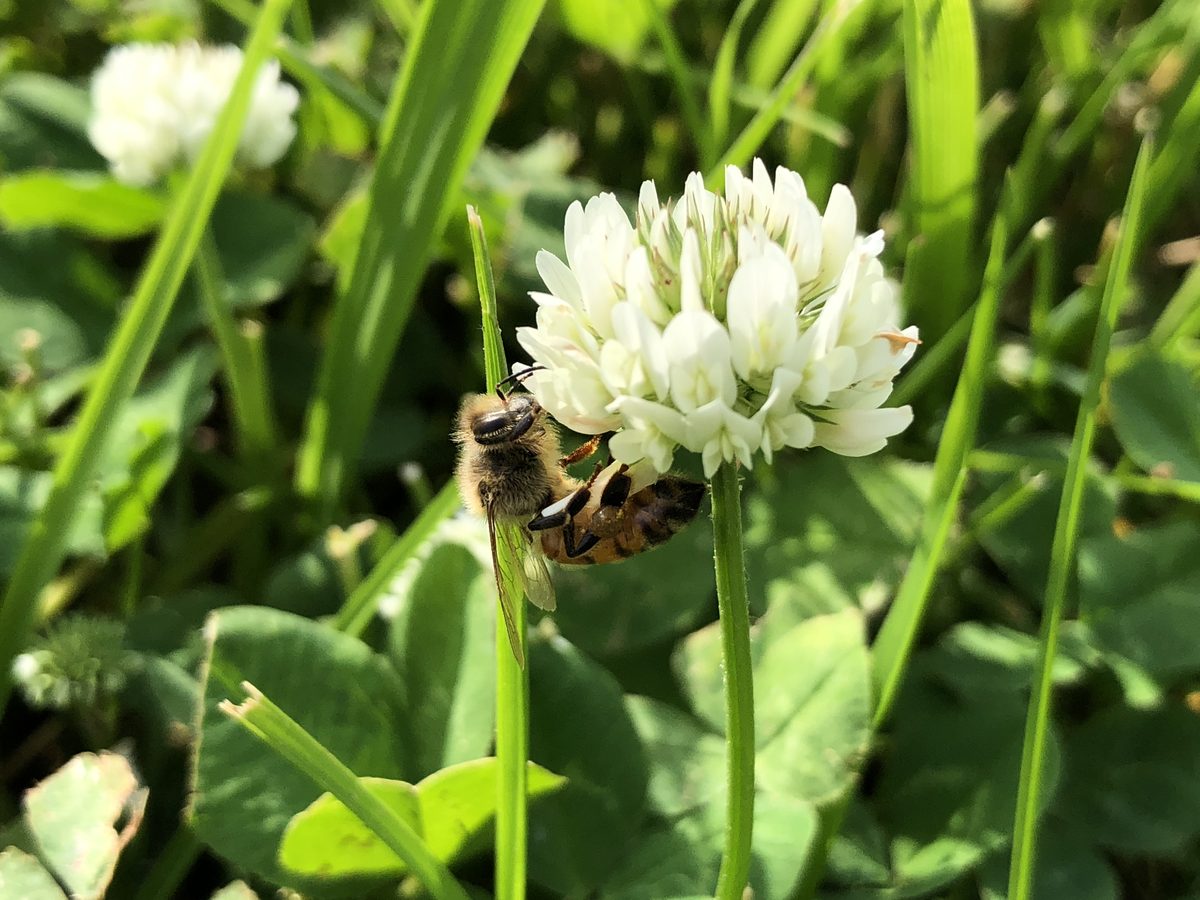
If you have a lawn, you may already have bee forage in it. University of Minnesota Extension calls white Dutch clover’s forage quality excellent, with high-protein pollen and high-sugar nectar. In Minnesota it blooms from late May into October, peaking in June. A “bee lawn” mixes clover and other low flowers into low-input grasses such as fine fescues. UMN’s suggested rate per 1,000 square feet is 4 pounds of fine fescue, 1.1 ounces of white clover and 1.2 ounces of self-heal.
- Mow high and less often. UMN suggests 3 inches or more, about every two to three weeks, and holding off while the clover is in full bloom.
- Watch the weed killer. Broadleaf herbicides, including many weed-and-feed products, are made to kill plants like clover.
- Seed at the right time. In Minnesota, UMN says the best time is dormant seeding in late fall, after the soil is too cold for seeds to sprout, with spring as the second choice.
Dandelions deserve a little slack too. Rutgers lists them as a good spring food source for honey bees, and Ohio State counts them as a major one in April and May. UMN is more lukewarm, but it agrees their early bloom is useful. If you can live with them until your trees are leafing out, your bees will use them.
Cover crops for a garden bed or field edge
If you have a bare bed or a bit of field, a flowering cover crop is a cheap way to fill a gap. SARE’s guide to cover cropping for pollinators says grass cover crops offer bees little, so pick flowering broadleaf species. It calls buckwheat the premier cover crop for beneficial insects, describes clover as a high-value honey plant, and says phacelia is extremely attractive to honey bees.
Buckwheat is the one I’d try first, because it blooms right in the summer gap. University of Missouri Extension says it flowers for 6 to 8 weeks, needs soil around 70°F to germinate, and is killed by the first light frost. In Missouri it can go in from about mid-May to late August for pollinators. Missouri also notes buckwheat honey is darker and stronger than clover honey.
Learn more: University of Minnesota Extension, “Planting and Maintaining a Bee Lawn”
Native plants and your region
Honey bees aren’t native to North America, and they do well on plenty of non-native garden plants. Washington’s noxious weed board makes that point and still recommends native plants first. They’re adapted to the local climate and soils, rarely need watering once established, and feed native bees as well. Mississippi State gives the same two reasons.
The best regional starting point I found is the Pollinator Partnership’s free ecoregional planting guides. You enter your zip code, download the guide for your ecoregion, and the plant lists start around page 16. The Xerces Society also publishes native plant lists by region, from Florida to the Maritime Northwest. For a beekeeper’s bloom calendar, look to your state extension service. UF/IFAS, for example, has separate month-by-month honey plant calendars for north, central and south Florida, and Clemson splits South Carolina at the fall line because the plants change so much across it.
Learn more: Pollinator Partnership, “Ecoregional Planting Guides”
How to plant, and why water matters
Plant in clumps
A foraging honey bee tends to stick with one kind of flower for the day. Mississippi State calls this flower constancy and recommends planting each species in large groups or drifts. If that doesn’t suit your yard, plant small groups of the same plant no more than a few yards apart, so bees can hop from one to the next. A single lavender here and a single salvia there is pretty, but it’s a poor setup for honey bees.
Buy plants that are safe for bees
A bee picture on the tag doesn’t tell you how the plant was grown. The Xerces Society says nursery plants, even ones sold as pollinator-friendly, are commonly treated with pesticides, and there’s no legal standard for the term. It urges buyers to avoid plants grown with neonicotinoids (clothianidin, dinotefuran, imidacloprid, thiamethoxam) and a few other systemic insecticides. These move into nectar and pollen and can persist longer in trees and shrubs. Xerces suggests asking for USDA Certified Organic plants or seeds, or asking the nursery directly which plants are neonic-free. Xerces says small local and native plant nurseries are where organic plants are most likely to turn up. If you grow from seed, check that the seed isn’t treated.
Your own sprays matter too. If you have to use a pesticide, Mississippi State says to look for low bee toxicity on the label and to apply in the evening after foragers are back in the hive. UMN adds that herbicides shouldn’t go on while flowers are blooming and pollinators are around.
Give them water
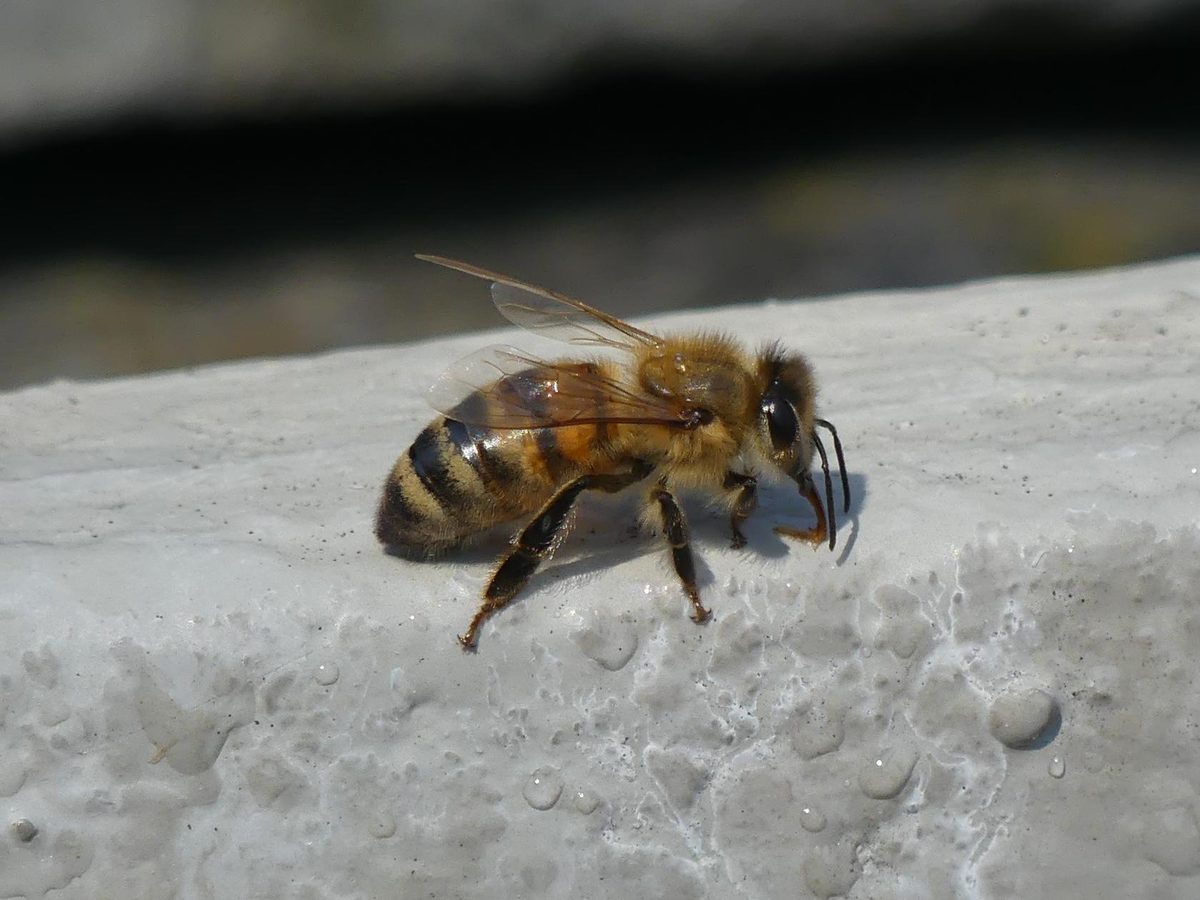
Bees use water to cool the hive, dilute food for larvae and dissolve crystallized honey, and Mississippi State says a dependable source is essential in hot, dry spells. It prefers running water, such as a small fountain or drip hose, over a still birdbath, partly because moving water doesn’t breed mosquitoes. Bees don’t like getting their feet wet, so add river rocks or another dry spot to land on. I’d set it up before the bees arrive, so yours is the first one they find. I list water among the site basics in the beginner timeline for ordering bees and gear.
Learn more: Xerces Society, “Buying Bee-Safe Plants” (PDF)
Plants to be careful with
Plants that are hard on bees
Some plants bees visit eagerly are toxic to them. Mississippi State says southern beekeepers wince at rhododendrons, azaleas and Carolina jessamine planted for bee forage, because the nectar is quite toxic to honey bees. It adds angel’s trumpet, oleander and bog rosemary as poisonous to bees and people alike. Clemson describes beekeepers finding dead bees piled at the entrance in early spring when yellow jessamine (the same plant) blooms, mostly in pine country where little else is open. It also says swamp titi (Cyrilla racemiflora) can cause “purple brood,” which kills larvae. Clemson says these effects seem to be temporary and can be handled with feeding, or by moving colonies away while the plants bloom.
Then there are plants that simply do nothing. Mississippi State points to forsythia, an early yellow shrub that produces nothing for honey bees.
Mountain laurel, rhododendron and “mad honey”
Some plants in the heath family make nectar with grayanotoxins, which can end up in honey and make people sick. The FDA’s Bad Bug Book says that in the eastern U.S., mountain laurel and sheep laurel are probably the most important sources, and in the West it names western azalea and California rosebay among several native rhododendrons. Not all rhododendrons produce the toxin. Symptoms include nausea, vomiting, dizziness and a slow heartbeat, usually starting soon after eating the honey. The FDA calls poisoning rare and rarely fatal, but says the risk is higher with honey from farmers who keep only a few hives, because commercial blending dilutes any toxin. Spring honey also tends to carry more of it. For a backyard beekeeper, I’d take that as a reason not to plant these near the hives, and to learn whether big stands grow within a couple of miles.
Invasive plants, even ones bees love
Here’s the awkward part. In parts of the South, some of the biggest nectar flows come from invasive trees. Mississippi State’s calendar credits north Mississippi’s main flow to Chinese privet and white clover, and south Mississippi’s longer flow mainly to Chinese tallow. Clemson still says not to plant or spread them. Its list of heavy-producing invasives includes Chinese tallow, Chinese and Japanese privet, Chinese wisteria, kudzu, chinaberry, tree-of-heaven, Callery pear, mimosa, Japanese honeysuckle and thorny olive. Clemson’s reasoning is that they crowd out native plants and reduce the variety honey bees need in the long run, and they do even more harm to native pollinators. Washington’s noxious weed board makes the same case for yellow starthistle out west. Penn State tells Pennsylvania gardeners to avoid anything on the state’s invasive plant list and remove it if it’s already there. I’d do the same with your own state’s list.
Learn more: FDA, Bad Bug Book, 2nd edition, “Grayanotoxins” chapter (PDF)
Frequently asked questions
Will planting flowers get me more honey?
Probably not much from a garden alone. Your bees forage over thousands of acres, and Ohio State says it’s generally not economical to grow a crop for bees by itself. Plantings help most by filling dearth periods, which keeps a colony steadier between flows. Your honey crop still depends mostly on the trees and wild plants around you.
What’s the single best thing to plant?
If you have room, an early-blooming native tree such as a red maple, a willow or a redbud. For a small yard, I’d pick a clump of an herb that blooms through midsummer, like oregano or basil left to flower. Either way, check your region’s list first.
Is it too late to plant anything this year?
Not for planning. In the North, late fall is when UMN recommends dormant seeding a bee lawn, so the seed sprouts early next spring. It’s also a good time to download your Pollinator Partnership guide and talk to a native plant nursery before spring orders start.
Should I rip out the azaleas by my hive?
I wouldn’t plant more, but a few shrubs among everything else in a 2-mile circle are a small share of what your bees bring home. Clemson describes the bee losses it sees from yellow jessamine and titi as temporary. If large stands of mountain laurel or wild rhododendron grow near your bee yard, ask your local club or state apiarist what beekeepers there do about spring honey.
Sources
- Couvillon, Schürch and Ratnieks, “Waggle Dance Distances as Integrative Indicators of Seasonal Foraging Challenges,” PLOS ONE (2014)
- Baveco et al., “An energetics-based honeybee nectar-foraging model used to assess the potential for landscape-level pesticide exposure dilution,” PeerJ (2016)
- Clemson Cooperative Extension, “Land Use and Forages”
- Ohio State University Extension, “Some Ohio Nectar and Pollen Producing Plants” (HYG-2168-98, PDF)
- Rutgers NJAES, “Blooms for Bees: How to Provide Pollen and Nectar Sources” (FS1222)
- UF/IFAS, “Florida Honey Bee Plants” (ENY-171)
- Mississippi State University Extension, “Gardening for Beneficial Bees in Mississippi” (Publication 2976)
- Mississippi State University Extension, “Mississippi Beekeeping Calendar”
- Penn State Center for Pollinator Research, “Best Practices for Forage and Habitat”
- University of Minnesota Extension, “Planting and Maintaining a Bee Lawn”
- SARE, “Cover Cropping for Pollinators and Beneficial Insects: Plant Selection”
- University of Missouri Extension, “Growing Buckwheat for Grain or Cover Crop Use” (G4163)
- Pollinator Partnership, “Ecoregional Planting Guides”
- Xerces Society, “Pollinator-Friendly Native Plant Lists”
- Xerces Society, “Buying Bee-Safe Plants” (PDF)
- Washington State Noxious Weed Control Board, “Bees and Noxious Weed Control” (PDF)
- U.S. Food and Drug Administration, Bad Bug Book, 2nd edition (PDF)
- Michigan State University Beekeeping, “Michigan Bee Plants with Dr. Zachary Huang” (YouTube)
Top photo: a honey bee on catmint in the USDA People’s Garden, Washington, D.C. Photo: USDA photo, public domain, via Wikimedia Commons
This article is general information, not professional advice. Invasive plant and pesticide rules vary by state. Check your state’s invasive species list before planting, and always follow the label on any product you use near bees.